Sahib Data Model
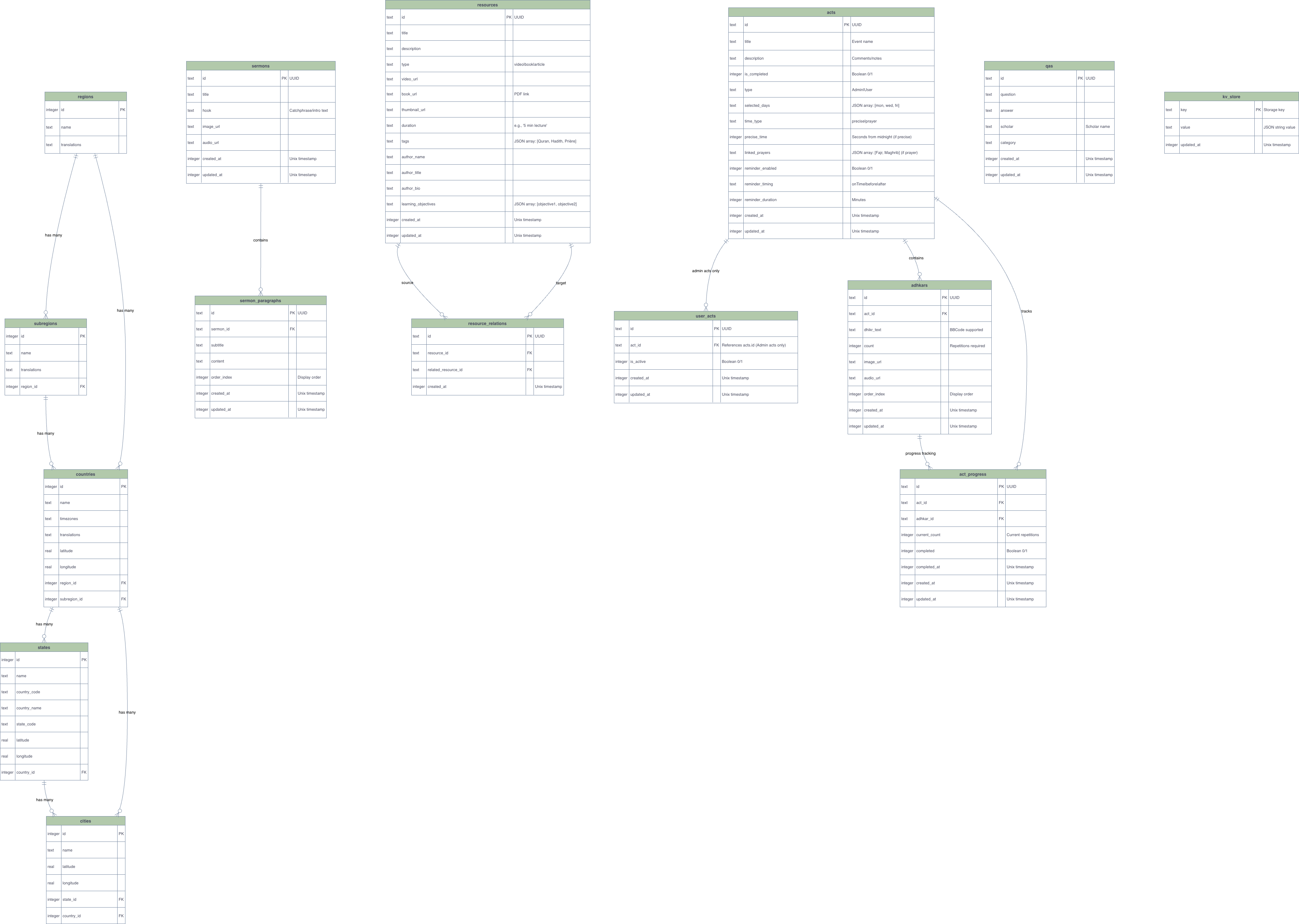
without translation table
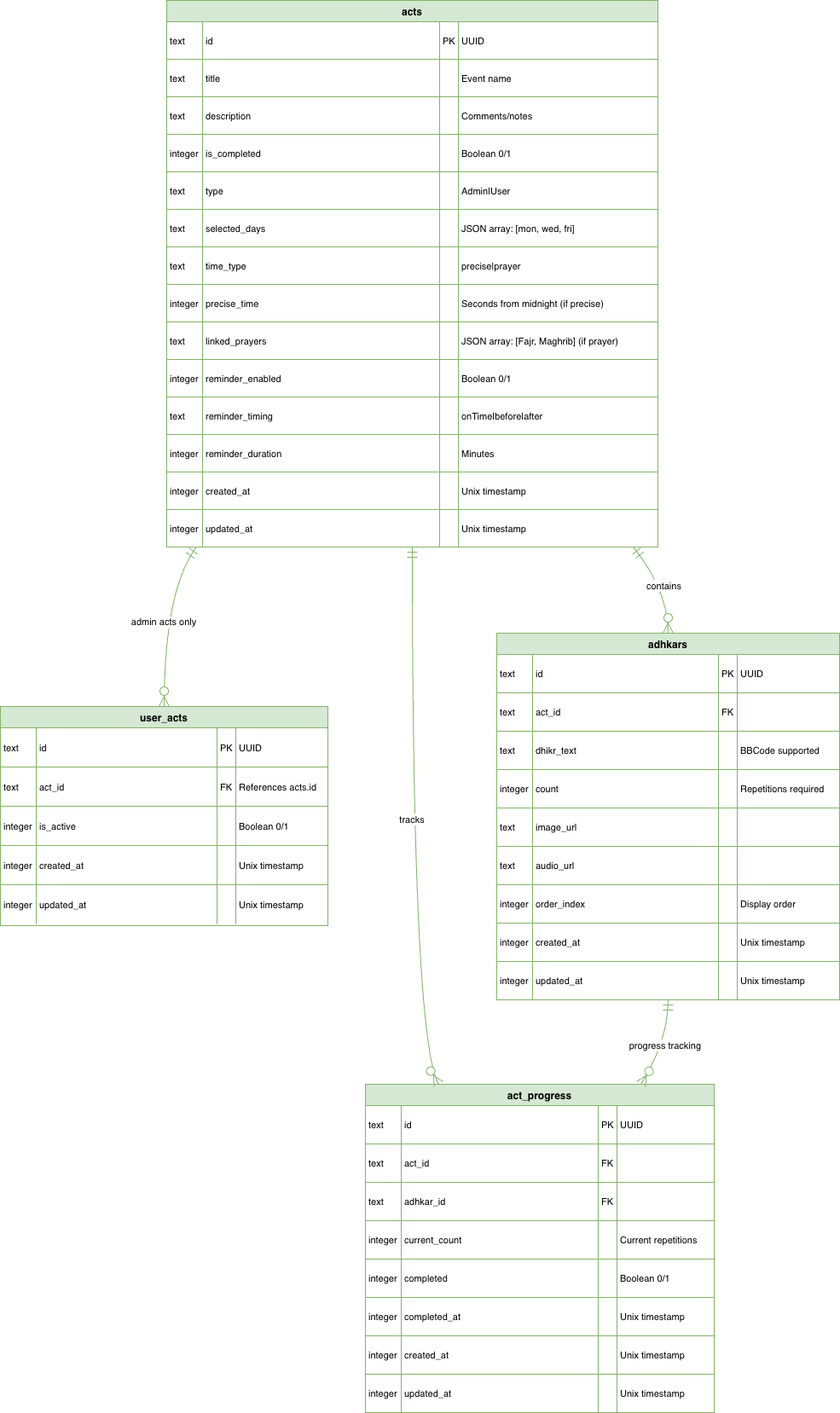
acts, adhkar, user_acts
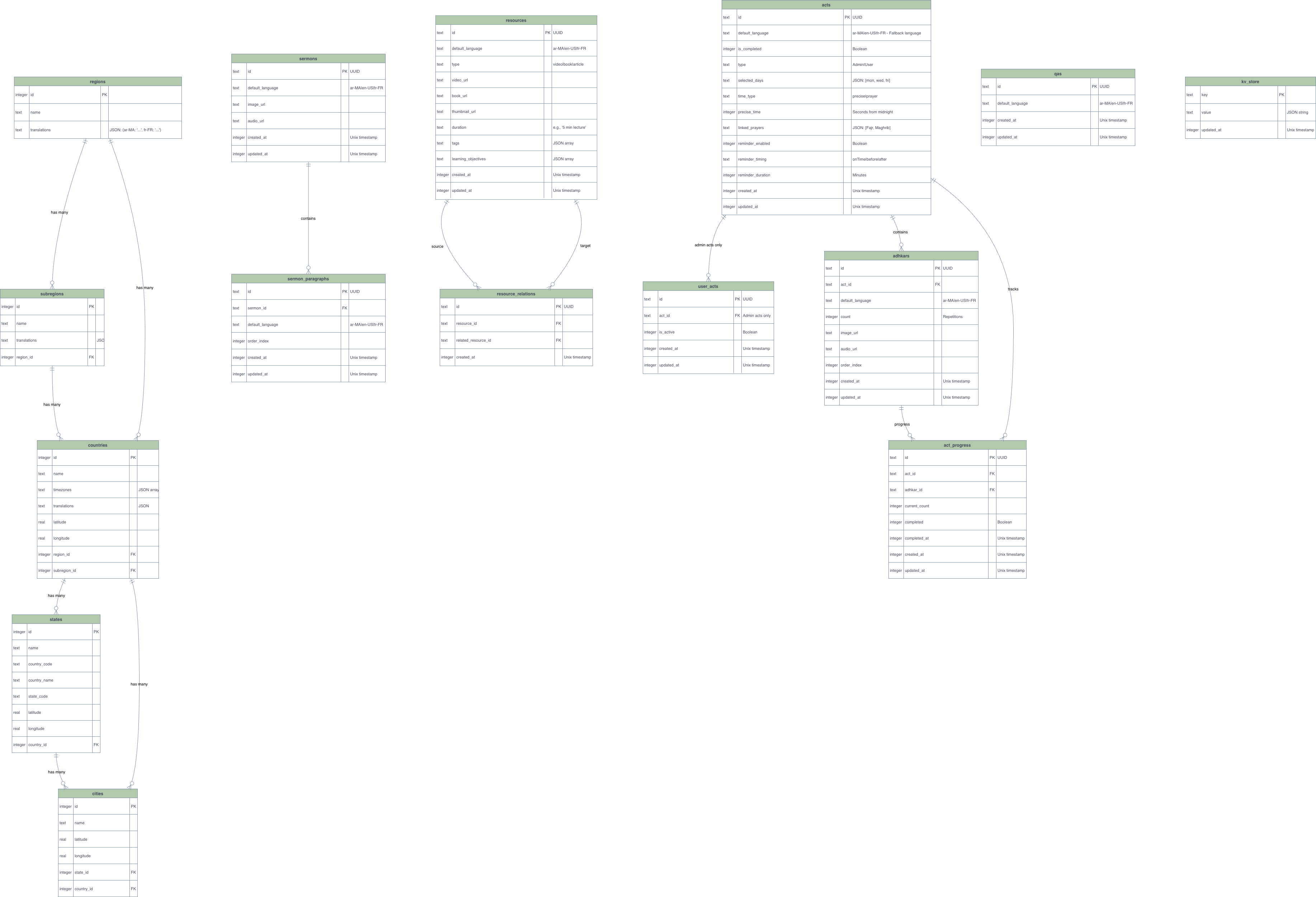
Saheb Mobile App - Database Schema
1. Entity Schema (Main Tables - No Translation Table)
All main tables with their columns. Translation relationships shown in diagram 2.
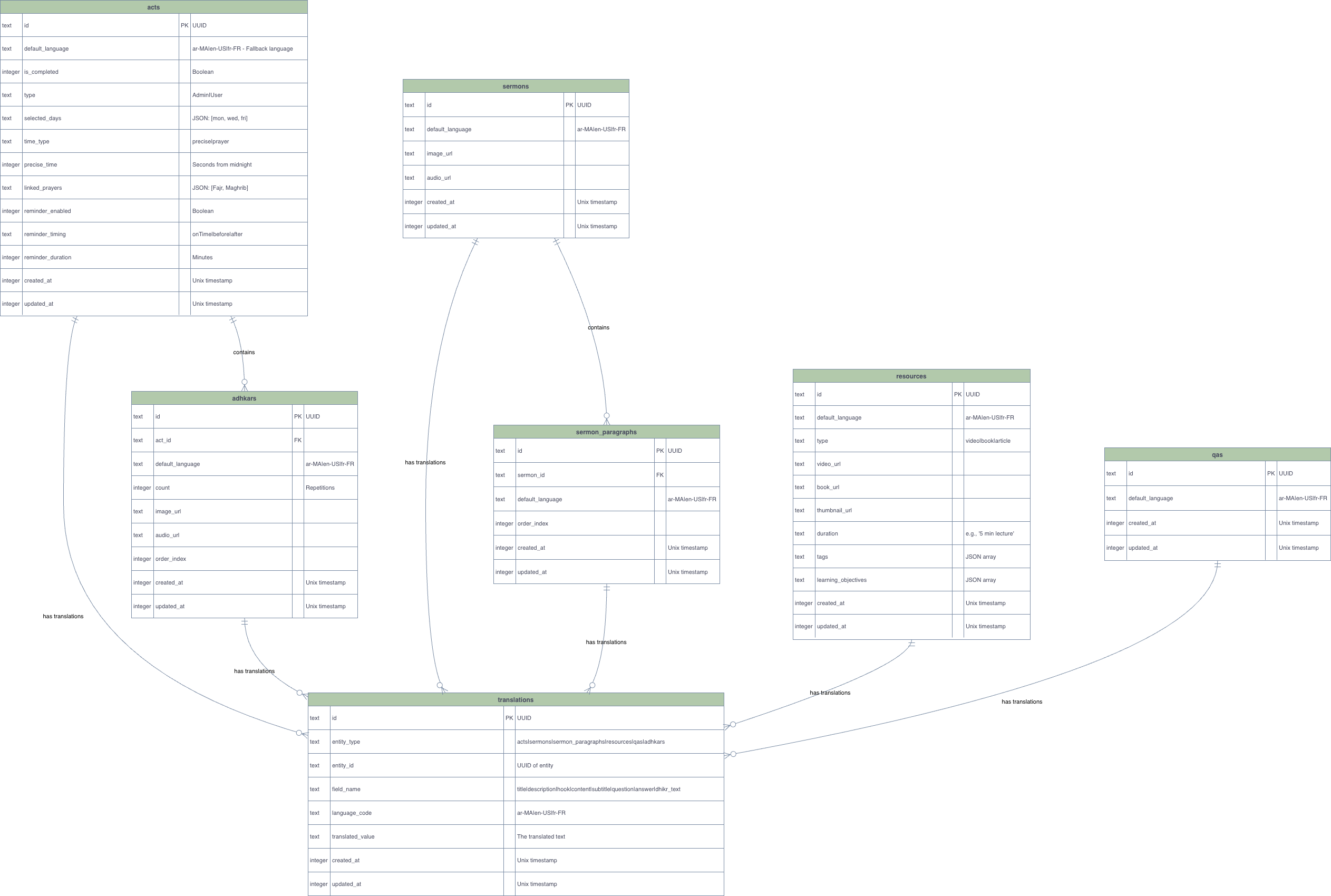
2. Translation Schema (Translation Relationships Only)
Shows how the global translations table relates to content tables.
Translation Strategy
regions, countries, subregions): Use JSON translations column
Content tables (acts, sermons, resources, qas, adhkars, sermon_paragraphs): Use global translations table
Fallback chain: Requested language → Record's default_language → Global default (en-US)
Drizzle Query Examples
EventBasic BasedTranslation Cron system:Query
import { db } from '@/src/db';
import { acts, translations } from '@/src/db/schemas';
import { eq, and, sql, inArray } from 'drizzle-orm';

// Get act title in specific language
async function getActTitle(actId: string, languageCode: string) {
  const result = await db
    .select({
      id: acts.id,
      title: translations.translatedValue,
    })
    .from(acts)
    .innerJoin(translations, and(
      eq(translations.entityType, 'acts'),
      eq(translations.entityId, acts.id),
      eq(translations.fieldName, 'title'),
      eq(translations.languageCode, languageCode)
    ))
    .where(eq(acts.id, actId))
    .limit(1);

  return result[0]?.title || null;
}
Query with Fallback Handling
// Get act with fallback: requested → record default → global default
async function getActWithFallback(
  actId: string,
  requestedLanguage: string,
  globalDefault: string = 'en-US'
) {
  const act = await db
    .select()
    .from(acts)
    .where(eq(acts.id, actId))
    .limit(1);

  if (!act[0]) return null;

  const recordDefault = act[0].defaultLanguage;

  // Try requested language, then record default, then global default
  const languages = [
    requestedLanguage,
    recordDefault,
    globalDefault,
  ].filter((lang, index, arr) => arr.indexOf(lang) === index); // Remove duplicates

  const translations = await db
    .select()
    .from(translations)
    .where(and(
      eq(translations.entityType, 'acts'),
      eq(translations.entityId, actId),
      inArray(translations.languageCode, languages)
    ));

  // Group by field_name and pick first available language
  const result: Record<string, string> = {};
  const fields = ['title', 'description'];

  for (const field of fields) {
    for (const lang of languages) {
      const translation = translations.find(
        t => t.fieldName === field && t.languageCode === lang
      );
      if (translation) {
        result[field] = translation.translatedValue;
        break;
      }
    }
  }

  return {
    ...act[0],
    ...result,
  };
}
Optimized Single Query with Fallback
// Single query with COALESCE-like fallback using SQL
async function getActTitleWithFallback(
  actId: string,
  requestedLanguage: string,
  globalDefault: string = 'en-US'
) {
  const act = await db
    .select({ defaultLanguage: acts.defaultLanguage })
    .from(acts)
    .where(eq(acts.id, actId))
    .limit(1);

  if (!act[0]) return null;

  const recordDefault = act[0].defaultLanguage;

  // Build fallback priority: requested → record default → global default
  const result = await db
    .select({
      title: sql<string>`COALESCE(
        MAX(CASE WHEN ${translations.languageCode} = ${requestedLanguage} THEN ${translations.translatedValue} END),
        MAX(CASE WHEN ${translations.languageCode} = ${recordDefault} THEN ${translations.translatedValue} END),
        MAX(CASE WHEN ${translations.languageCode} = ${globalDefault} THEN ${translations.translatedValue} END)
      )`.as('title'),
    })
    .from(acts)
    .leftJoin(translations, and(
      eq(translations.entityType, 'acts'),
      eq(translations.entityId, acts.id),
      eq(translations.fieldName, 'title'),
      inArray(translations.languageCode, [requestedLanguage, recordDefault, globalDefault])
    ))
    .where(eq(acts.id, actId))
    .groupBy(acts.id);

  return result[0]?.title || null;
}
Get Multiple Fields with Fallback
// Get multiple translatable fields with fallback
async function getActTranslations(
  actId: string,
  requestedLanguage: string,
  fields: string[] = ['title', 'description'],
  globalDefault: string = 'en-US'
) {
  const act = await db
    .select({ defaultLanguage: acts.defaultLanguage })
    .from(acts)
    .where(eq(acts.id, actId))
    .limit(1);

  if (!act[0]) return null;

  const recordDefault = act[0].defaultLanguage;
  const languages = [requestedLanguage, recordDefault, globalDefault];

  // Get all translations for this act and requested fields
  const allTranslations = await db
    .select()
    .from(translations)
    .where(and(
      eq(translations.entityType, 'acts'),
      eq(translations.entityId, actId),
      inArray(translations.fieldName, fields),
      inArray(translations.languageCode, languages)
    ));

  // Build result with fallback logic
  const result: Record<string, string> = {};

  for (const field of fields) {
    for (const lang of languages) {
      const translation = allTranslations.find(
        t => t.fieldName === field && t.languageCode === lang
      );
      if (translation) {
        result[field] = translation.translatedValue;
        break;
      }
    }
  }

  return result;
}
Helper Function: Reusable Translation Getter
// Generic helper for any entity type
async function getTranslatedValue(
  entityType: 'acts' | 'sermons' | 'resources' | 'qas' | 'adhkars' | 'sermon_paragraphs',
  entityId: string,
  fieldName: string,
  requestedLanguage: string,
  recordDefaultLanguage: string,
  globalDefaultLanguage: string = 'en-US'
): Promise<string | null> {
  // Try requested language first
  let translation = await db
    .select()
    .from(translations)
    .where(and(
      eq(translations.entityType, entityType),
      eq(translations.entityId, entityId),
      eq(translations.fieldName, fieldName),
      eq(translations.languageCode, requestedLanguage)
    ))
    .limit(1);

  if (translation[0]) return translation[0].translatedValue;

  // Fallback to record's default language
  if (recordDefaultLanguage && recordDefaultLanguage !== requestedLanguage) {
    translation = await db
      .select()
      .from(translations)
      .where(and(
        eq(translations.entityType, entityType),
        eq(translations.entityId, entityId),
        eq(translations.fieldName, fieldName),
        eq(translations.languageCode, recordDefaultLanguage)
      ))
      .limit(1);

    if (translation[0]) return translation[0].translatedValue;
  }

  // Fallback to global default
  if (globalDefaultLanguage !== requestedLanguage && globalDefaultLanguage !== recordDefaultLanguage) {
    translation = await db
      .select()
      .from(translations)
      .where(and(
        eq(translations.entityType, entityType),
        eq(translations.entityId, entityId),
        eq(translations.fieldName, fieldName),
        eq(translations.languageCode, globalDefaultLanguage)
      ))
      .limit(1);

    if (translation[0]) return translation[0].translatedValue;
  }

  return null;
}

// Usage example
const act = await db.select().from(acts).where(eq(acts.id, 'act-1')).limit(1);
const title = await getTranslatedValue(
  'acts',
  'act-1',
  'title',
  'fr-FR', // User's current language
  act[0].defaultLanguage, // Record's default (e.g., 'ar-MA')
  'en-US' // Global default
);
Design Notes
translations table (including English)
Per-Record Fallback: Each record has default_language for fallback when requested translation missing
Location Tables: Use JSON translations column (prepopulated data)
Content Tables: Use global translations table (dynamic content)